

Strategies to Mitigate Cross Contamination of Non-critical Medical Devices
This issue brief was researched and written by members of the 2021 APIC Practice Guidance Committee in collaboration with members of the 3M clinician research team. The Association for Professionals in Infection Control and Epidemiology (APIC) gratefully acknowledges the following individuals for their valuable contributions.
Objective and Scope
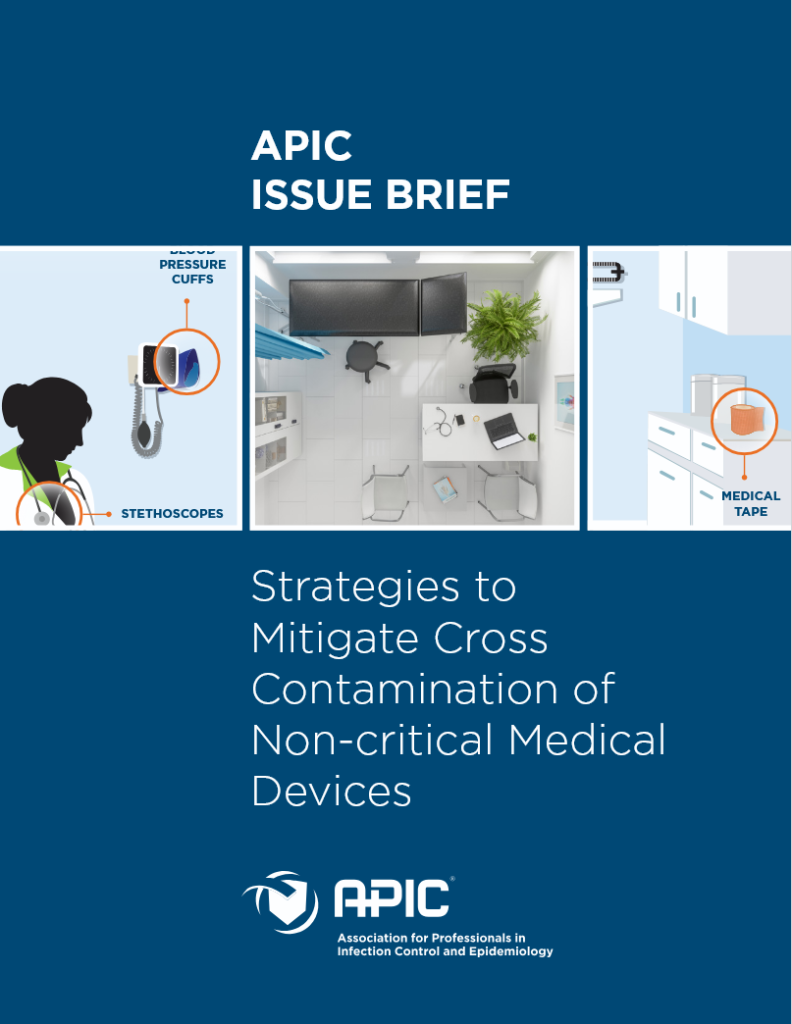
This issue brief addresses high-level themes regarding contamination of multiple-use, non-critical medical items frequently used across patient care settings. The goal is to shed light on best practices for minimizing infection risk from these types of items. The brief covers non-invasive, non-critical medical devices such as blood pressure cuffs, oxygen saturation monitors, and stethoscopes, as well as therapy toys and other multiple-use items that come in contact with intact skin, such as medical tape. It does not cover contamination of semi-critical or critical medical devices.
The brief addresses mitigation of cross contamination for pediatric and adult patient populations across the continuum of care. However, certain patient populations who are at increased risk of infection from contaminated medical devices/items, such as immunocompromised individuals, are excluded from the population scope.
Background
Preventing healthcare-associated infections (HAIs) requires a comprehensive infection prevention program that encompasses all potential reservoirs in the chain of infection (Figure 1),1 including environmental surfaces, shared medical devices, and other fomites (inanimate objects or surfaces that can be contaminated with pathogens). The program must have effective policies and procedures for appropriate cleaning and disinfection of reservoirs that can be cleaned and disinfected, as well as clear guidance for the safe handling and storage of all equipment and basic items used in the delivery of healthcare.

Non-invasive portable clinical items shared among patients are part of the patient’s immediate surroundings and may pose a threat of pathogen transmission.2 These items are not typically assigned to a specific patient and may be overlooked when establishing routine disinfection practices. Micro-organisms can live on these items’ surfaces for long periods, with the micro-organisms’ life spans depending in part on the material of the surface, the ambient air temperature and humidity, and the presence of organic material.3-5 The occurrence of infection from contaminated environmental surfaces and non-critical medical devices has been documented in the literature.6-8 In a 2015 literature review of research on contamination of non-invasive portable clinical items and HAIs, Livshiz-Riven and colleagues2 found that between 23% and 100% of the items investigated in 13 qualifying studies were contaminated; up to 86% of items were contaminated with pathogenic organisms; and multi-drug resistant organisms (MDROs) were found on up to 25% of items. The authors concluded that inappropriate disinfection practices increase the risk of HAIs transmitted from such items.
Additional Resources
View Non-Critical is Critical webinar here!
Download the Non-Critical is Critical Infographic
Watch the video
